
Designed by Edoardo Eibenstein, illustrated by Ryan Lynch, published by Fiammingo Games. Part of The Cozy Bundle alongside So Happy You’re Here! and Nemi, launching on Kickstarter September 8, 2026.
Burn the witches! That’s what they said in Monty Python’s Holy Grail, and that’s the motto I stand by! Nobody likes witches! They’re a rotten lot, all they do is stir stinky pots and cast horrible spells on people and turn them into toads and… and what’s happened over the last couple of decades? Everybody likes witches these days. No, more than that, everybody wants to be a witch. Films like The Craft and Practical Magic have shown that modern witches are people we want to emulate. Yeah, well, what about the ones in the woods, eh? Bet they’re still horrible! Ah, I see. They’re not, and they never were. They live in cosy cottages with beautifully tended gardens and they keep the roads safe and look after the animals, and you know what? I think I want to be a witch too. Well, this cosy board game is my perfect chance!

First Impressions
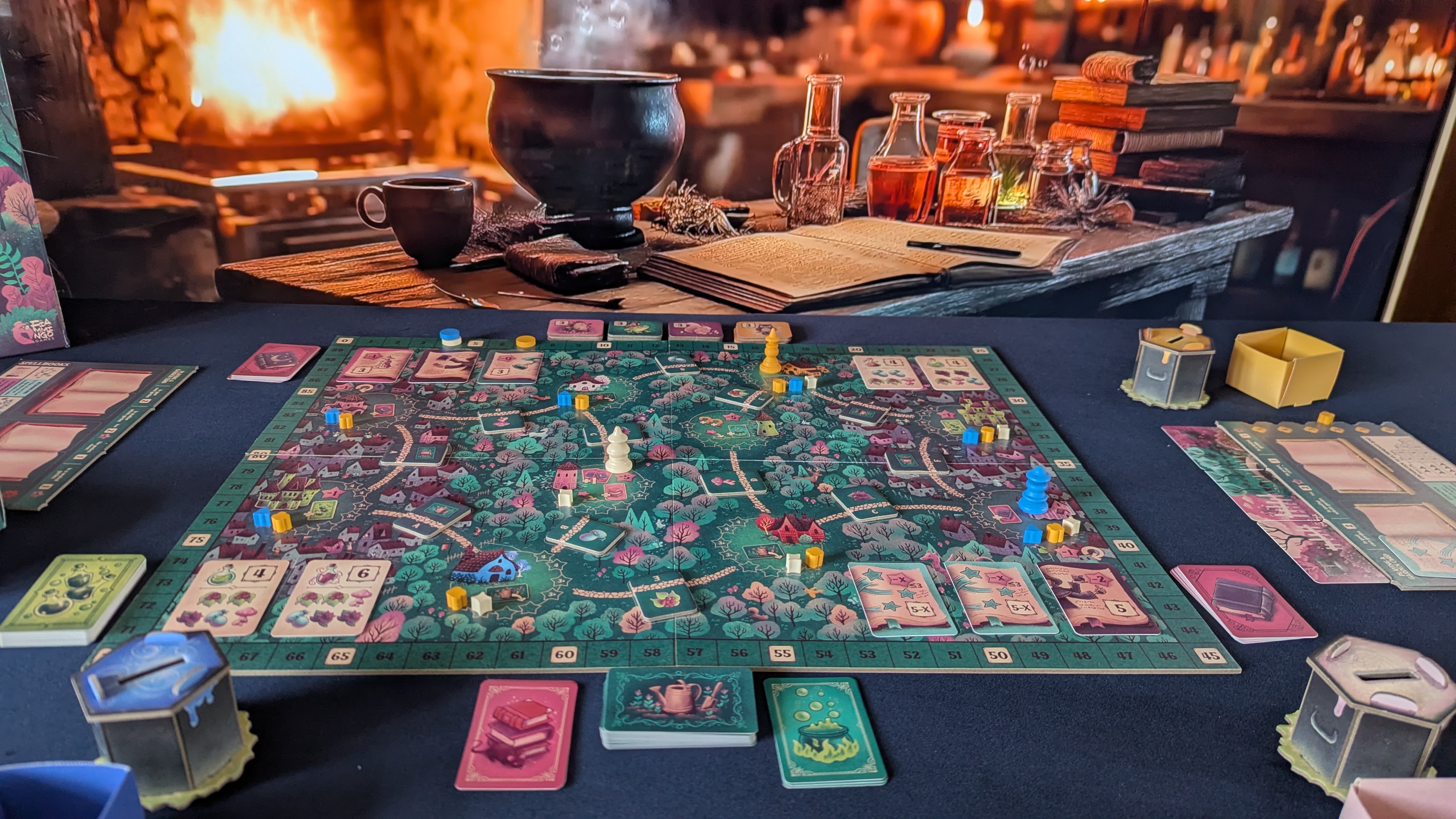
Cosy board games tend to be beautiful and this is top tier. Outrider Creative’s artwork is gorgeous (check out the way the garden cards blend together) and the green/purple/pink colour scheme is sumptuous and on-theme. This is a world you’ll want to live and breathe in. Seriously, look at it. And if my low-grade pictures don’t get the point across, check out Instagram, where The Witches’ Road is currently dominating. I’m not sure I’ve seen a more aesthetically pleasing board game for quite some time, and that’s quite the statement when you consider the high level of modern board game design. Every card, token, playing piece carries the theme so that this feels like a cohesive whole. The table presence is outstanding without having additional, unnecessary elements. This one’s a looker.
There’s something more important to me than looks, however. I like it when I can play a role in a game, where I can slip into the world, and I found that the easiest way to understand The Witches’ Road is to think of it as a game about making a journey through a magical woodland while gradually making that woodland safer. You aren’t playing witches who are out to curse their neighbours. Instead, you’re helping the people and creatures who live along the road, gathering magical resources, brewing potions, studying arcane knowledge and creating safe gardens for magical animals.
The interesting part is that you are doing this alongside your fellow witches, but not entirely for them. The Witches’ Road is semi-cooperative. Everyone needs to work towards the same broad objective, but individual players are competing to become the witch who has contributed the most by the end of the game. With that said, it’s time for an atmospheric introduction to the game itself…

Oh, to live as a witch…
Somewhere beyond the edges of the map, where the last cottage lights give way to unlit trees, there is a wood that has forgotten what it feels like to be safe. Its roads are unmarked. Its clearings are unclaimed. The creatures that live deeper in – quiet, cautious, half-glimpsed things with fur or feathers or something stranger – have no gardens to settle in, no reason to trust the paths that wind between the two great cities on either side of the forest.
That is where you come in.
You are a witch. Not the pointed-hat, cauldron-of-trouble kind that shows up in warning tales told to children, but the other sort: the kind that mends fences, brews something warm for a cold traveler, and remembers which mushrooms are for eating and which are for leaving well alone. You have a cottage of your own, tucked somewhere along the wood’s edge, and a garden that is currently more hope than harvest. Your task, along with every other witch drawn to this place, is to make the wood livable again, for the humans who need to travel it, and for the magical creatures who need somewhere gentle to land.
The two cities want to be connected. Right now, the road between them runs straight through unclaimed woodland, and nobody in their right mind travels it after dark. Every witch in the woods has taken it upon themselves to fix that, one stretch of road at a time, by pouring their magic into the paths until they’re safe enough to walk. As the roads brighten, they don’t just become passable. They start yielding better resources, and the wildlife starts paying attention. Arcane animals, drawn by the growing sense of safety, begin looking for gardens to call home. Yours, ideally. Though you won’t be the only witch they’re considering.
Everyone on The Witches’ Roads needs the same thing. Every witch benefits when the roads improve, when the cities connect, when the wood stops being a place people whisper about and starts being a place people simply walk through. So you’ll find yourself helping your rivals along the way. You’ll be tending their gardens, using roads they’ve already improved, occasionally footing the bill for a public good you know someone else is about to enjoy for free. It’s a community effort. It’s also a competition. The witch who has done the most for the woods, through knowledge gathered, potions brewed, animals welcomed, and magic spent, will be remembered as the one who truly built the road. Everyone else just walked it.

How To Play
The board shows ten Locations connected by a network of Roads, all threading between two cities at opposite ends of the wood. Each player sets up their own cottage as a home base and starts the game as a fledgling witch with very little to their name beyond good intentions and an empty cauldron. Yep, you get a genuine three-dimensional cauldron model that sits on the table in front of you and fills up as you collect resources over the course of the game. Read that again: your own miniature cauldron. Oh yes, oh thank you.
Turns are built to be quick to parse, even if the decisions behind them aren’t. On your turn, you move your witch along a road to an adjacent Location, take the action available there, and collect whatever resources that road provides for having traveled it. Then play passes to the next witch. That’s the whole shape of it: the depth comes from what’s available at each stop and how badly you need it compared to everyone else.
The heart of the game is spending Magic tokens to improve the Roads themselves. An improved road is safer, which matters for the shared goal of connecting the two cities, and it also upgrades the resources it hands out to anyone who travels it afterward, including your opponents. This is where the game’s gentle tension lives: you might improve a road because you need what it produces right now, fully aware that the next three players to pass through are going to benefit from your generosity. Leave it for someone else to fund instead, and you might be waiting a while.
When your travels take you into one of the cities, you can visit its Library to gather arcane lore, or set up shop brewing potions for the townspeople using the resources you’ve gathered in your cauldron. These are among the more direct ways to convert raw materials into the prestige that ultimately decides the winner.
Away from the cities, the wood itself holds your cottage, the cottages of other witches, and the Venerable Witches: older, wiser figures who hand out tasks and assistance to anyone willing to visit. You can tend your own garden to prepare it for arcane animals, or stop by another player’s garden to help tend theirs, which is one of the game’s nicer touches: helping a rival isn’t a wasted turn, it’s often a genuinely useful one, since a thriving woodland benefits everybody trying to finish it.
As roads improve and the wood grows safer, magical animals begin to appear looking for gardens to settle in. A bit like that squirrel that decided to settle in my garden, enjoying a wonderful existence in which he scoffed every single strawberry and tomato I had lovingly grown this year. Attracting them to your own garden, rather than a neighbour’s, is one of the more satisfying long-game payoffs of investing early in your cottage’s surroundings.
Play continues until the two cities are finally connected by a fully safe road. This is a milestone that every witch will have a hand in reaching, whether they meant to help each other or not. Once that happens, scores are tallied based on contributions to the wood’s wellbeing and the advancement of each witch’s own magical study. The witch who has done the most, for the community and for themselves, wins.
It’s a game about building something together while quietly keeping score of who built more of it. Which, if you think about it, is a very witchy way to spend an evening.

How Well Does It Play?
Bit of an early spoiler here: this game is excellent.
I love that us witches can choose our own route and chase our own priorities. You don’t have to go round the board in the same direction endlessly. You can turn off at this fork, backtrack if you wish, and get focused on the elements of the game that you want to prioritize. There isn’t an overwhelming amount of choice, but there is plenty, so that each turn can feel very different to the last whilst maintaining the overall atmosphere.
The road improvement mechanic proves to be compelling: there’s a basic resource to collect on each road you take, but complete the improvements on both ends of each road and you unlock a much better reward: double potion tokens, for example. You may feel as if you need to be careful about spending your Magic tokens on road improvements, but remember this is a semi-cooperative game. Getting those roads open will benefit everyone. Plus, if you’ve spent the most on improving a particular road, you will get a larger share of the points reward when it opens, which is an excellent way to encourage big spending. Seriously, splash those tokens about at every chance you get. Even if you’ve only placed one token on that road when someone else completes it, you will at least get a portion of the points reward. Spend! (This is not my attitude while out with the fam in town, mind you, so don’t get any funny ideas.)
The cauldron is a well-realised mechanic. It’s fun to fill it with ingredients, and there’s a tense dose of guesswork when claiming a potion: you have to try and remember what’s in your cauldron (no peeking). The risk/reward element is well judged and enjoyable. You’ll be surprised how quickly you lose track of what’s brewing. Or maybe that’s just me… Emptying the cauldron is best accompanied by a drumroll. Get it right, you score the potion at the cost of all the ingredients, even the spares. On the first of many times that I lost track of what I had gathered, I wasted seven additional ingredients in my effort to secure a potion, an indication that timing is critical here too. You don’t want to keep going round and round the board, stuffing ingredients into your cauldron, and blowing the lot on a single potion. Get the contents wrong during your guess, and you lose all but two ingredients. This mechanic dwells deep in risk/reward territory, and I love it.
It might be a semi-cooperative game, but you still need to be on top of what’s happening around the board. I’ve mentioned earlier that you should be slap-happy with your Magic tokens for road improvements… but this might not be the best strategy for the entire time. Remember, the game ends if the two cities are joined by improved roads across the board, so if you’re lagging behind points-wise then you might choose to skip improvement on your turn to buy a little extra time. Vice-versa if you’re leading.
The garden cards (which are stunning from both an art and a design perspective) provide an interesting tactical dilemma, depending on whose garden you’re in (always a serious consideration). When you land on your own cottage space, laying a garden card gives a nice and easy two points. Take the same action at an active player’s cottage and you get those two points plus an extra magic point… but you also give a point to the owner of that cottage. An extra reward for you, and for someone else.
Yep, it’s the niggle section. Those tiny magic tokens are tricky for sausage fingers. They can prove hard to pluck from their storage box, and have a habit of firing off into nooks and crannies, which lively cats then zoom after (part of this problem may only occur in my house, to be fair).
The pink and the purple on the garden cards are a little too close in shade. It could just be my eyes, but I struggled to see the difference unless I had one of each close together. And if I’m going to really reach for things to moan about (and this is really reaching), then a couple of the resource spaces on the beautiful, busy board can be a little difficult to make out during set up. None of these niggles add up to much of anything: The Witches’ Road is simply too enjoyable for anything to dent that feeling of fun.

Conclusion
I gave away the conclusion earlier, didn’t I?
It’s a busy life for a witch, and there’s enough activities to focus on so that repeated plays remain fun. It gives ample opportunity for switching up your strategy too. You might want to focus more on those high-scoring potions next time, or rattling through more spells (something I forgot to use last playthrough and I won’t forget again). Despite the amount of options available per turn, crucially this is not a complicated game to pick up and play. It hinges on a few basic elements per turn: move to a space, improve the roads you take if you wish, collect resources, take the action at the space you land on. You always feel like you’re moving your witchy life forward. The main achievement here is that The Witches’ Road doesn’t feel like a few mini-games tacked together: the elements function as a cohesive whole.. It feels very folksy and mystical and like you’re actually taking up a witch’s pastimes. It’s easy to believe that a witch could live like this… and maybe you could too.
The Witches’ Road is strongly recommended, and is a possible future gateway classic.
The Cozy Bundle, featuring The Witches’ Road, launches on Kickstarter September 8, 2026.
The Witches’ Road would make a great game for an Autumn evening – and so would these five autumnal games.
Leave a Reply